

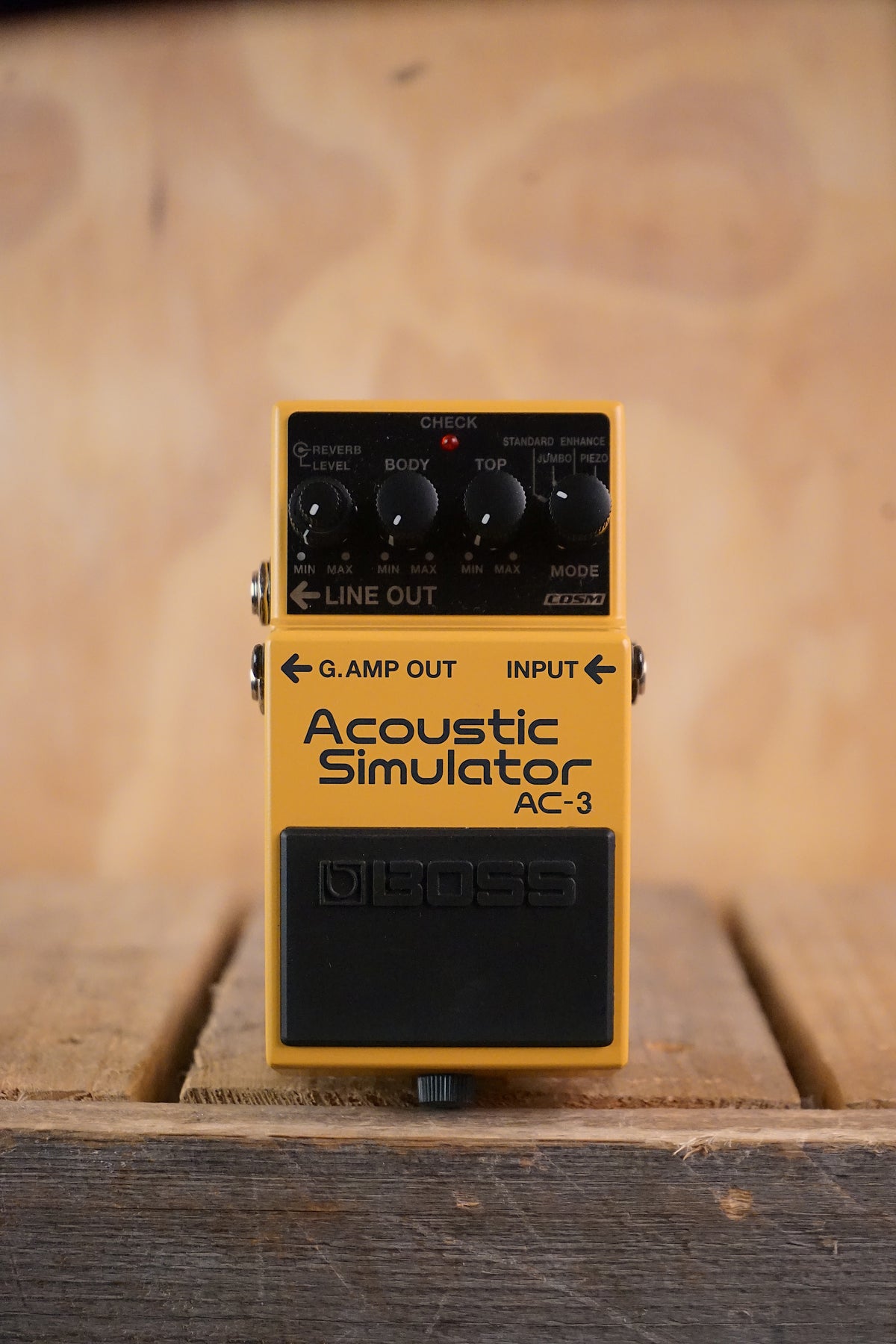

Boss AC-3 Acoustic Simulator Guitar Effects Pedal, (Used)
Pairs well with
Description
The Boss AC-3 Acoustic Simulator is a versatile digital guitar effects pedal designed to recreate the character and tonal response of an acoustic guitar using a conventional electric guitar. Combining Boss's COSM modelling technology with four selectable acoustic voicings, detailed tone-shaping controls and built-in digital reverb, the AC-3 provides a practical solution for guitarists who want to introduce acoustic-style sounds into their performances without changing instruments.
With Standard, Jumbo, Enhance and Piezo modes, the Boss AC-3 offers a range of acoustic-inspired tones, from balanced steel-string sounds to fuller-bodied resonance and brighter, more percussive textures. Dedicated Top and Body controls allow players to fine-tune the simulated acoustic characteristics, while the integrated reverb adds natural ambience and depth.
One of the AC-3's most useful features is its dual-output arrangement, allowing the pedal to be connected to a conventional guitar amplifier and a separate PA system or recording setup. This makes it particularly useful for live performers who need to switch between electric and acoustic-style sounds during a song or set.
This particular Boss AC-3 is presented in Very Good Pre-Owned Condition and is supplied without a power supply. It can operate using a standard 9V battery or a suitable regulated 9V DC centre-negative adapter.
For guitarists seeking a second-hand acoustic simulator pedal with intuitive controls, useful stage connectivity and the reliability associated with Boss effects, the AC-3 is an appealing addition to any pedalboard.
At A Glance
|
Detail |
Information |
|---|---|
|
Brand / Model |
Boss AC-3 |
|
Effect Type |
Acoustic Guitar Simulator |
|
Technology |
COSM Digital Modelling |
|
Acoustic Modes |
Standard, Jumbo, Enhance, Piezo |
|
Built-In Effects |
Digital Reverb |
|
Condition |
Very Good – Pre-Owned |
|
Power |
9V DC / 9V Battery |
|
Power Supply |
Not Included |
Pre-Owned Condition Report
Very Good Condition
This Boss AC-3 Acoustic Simulator is presented in Very Good Pre-Owned Condition, indicating some cosmetic wear consistent with careful previous ownership.
Its familiar Boss compact pedal enclosure provides a robust and practical design suitable for use on pedalboards, in rehearsal rooms and during live performances.
The pedal features a clearly arranged control layout, with the main acoustic simulation settings accessible directly from the top panel.
Specific cosmetic marks, scratches or other signs of wear have not been individually documented. Please study the product photographs for a closer assessment of this particular pedal.
Power Supply Not Included
No power supply is included with this Boss AC-3.
The pedal can be powered using a suitable Boss PSA-series 9V DC centre-negative adapter or a compatible regulated pedalboard power supply.
It also supports operation using a single 9V alkaline battery. A battery has not been confirmed as included.
What's Included
- Boss AC-3 Acoustic Simulator Guitar Effects Pedal
Not Included: Power supply.
No original box, manual or additional accessories have been confirmed.
Fair Deal Music Quality Control Assessment
Fair Deal Music's pre-owned pedal assessment considers the essential areas of general operation, including input and output connections, control response, footswitch functionality and the performance of the effect circuit.
For the Boss AC-3, relevant checks include all four acoustic simulation modes, the Top and Body controls, reverb operation, output routing and general signal performance.
Individual testing results for this particular pedal have not been separately supplied.
Key Features
-
COSM Acoustic Modelling: Creates acoustic-style guitar tones from a conventional electric guitar signal.
-
Four Acoustic Simulation Modes: Standard, Jumbo, Enhance and Piezo.
-
Dedicated Top Control: Adjusts the brightness and high-frequency character of the simulated acoustic sound.
-
Dedicated Body Control: Shapes the body resonance and low-frequency fullness.
-
Built-In Digital Reverb: Adds spaciousness and ambience without requiring a separate pedal.
-
Reverb/Level Control: Adjusts effect output and the amount of reverb.
-
Dual Output Connections: Separate Guitar Amp Out and Line Out connections.
-
Flexible Live Performance Routing: Route acoustic-style sounds to a PA while retaining an electric amplifier connection.
-
Buffered Bypass: Maintains a buffered signal path when the effect is disengaged.
-
Compact Boss Construction: Familiar, durable stompbox enclosure.
-
Battery or Adapter Operation: Suitable for standalone use or integration into a powered pedalboard.
-
Very Good Pre-Owned Condition: An attractive alternative to purchasing a new acoustic simulator.
Why You'll Love It
The Boss AC-3 is particularly useful for guitarists who need acoustic-style sounds during a performance but do not want to carry a separate acoustic guitar.
Its four modelling modes provide a range of tonal characters, while the Top and Body controls allow players to adjust the sound to suit different electric guitars and amplification systems.
The integrated reverb is another practical advantage, adding depth and ambience without requiring an additional effects pedal.
Perhaps most importantly, the AC-3's dedicated outputs make it particularly effective for live use, allowing electric and simulated acoustic signals to be routed to different destinations.
Although an acoustic simulator is not an exact substitute for the physical response of an acoustic instrument, the AC-3 offers a convenient way to introduce contrasting textures into a guitar rig.
Detailed Features & Benefits
Boss COSM Acoustic Modelling Technology
The Boss AC-3 uses the company's COSM modelling technology to process the incoming electric guitar signal and recreate characteristics associated with acoustic guitar construction and resonance. Rather than simply applying conventional EQ, the pedal uses digital processing to alter the tonal response and introduce acoustic-style characteristics. This makes it particularly useful for musicians who need to move between conventional electric guitar tones and brighter, more resonant acoustic-inspired sounds without changing instruments.
Four Distinct Acoustic Simulation Modes
The AC-3 offers four selectable acoustic simulation modes, each designed to provide a different tonal character. Standard produces a balanced acoustic-style response, Jumbo emphasises the fuller resonance associated with larger-bodied acoustic guitars, Enhance creates a brighter, more articulate sound, and Piezo recreates the direct, percussive character commonly associated with acoustic pickup systems. These modes allow guitarists to adapt their sound to different songs and playing styles without relying on complicated programming or preset menus.
|
Mode |
Tonal Character |
Best Applications |
|---|---|---|
|
Standard |
Balanced and natural acoustic-style sound |
General rhythm playing and accompaniment |
|
Jumbo |
Fuller body and stronger low-frequency character |
Open chords and powerful strumming |
|
Enhance |
Brighter, more articulate acoustic texture |
Fingerpicking and defined rhythm parts |
|
Piezo |
Direct, percussive pickup-style response |
Live band mixes and cutting acoustic parts |
Dedicated Top Control
The Top control adjusts the high-frequency character of the simulated acoustic guitar, helping players balance brightness, clarity and attack. Increasing the control can bring additional definition to picked notes and strummed chords, while lower settings provide a softer, less pronounced treble response. This is particularly useful when using electric guitars with different pickup configurations, allowing the AC-3 to be adjusted for the natural brightness of single-coils or the warmer response of humbuckers.
Dedicated Body Control
The Body control adjusts the resonance and perceived fullness of the acoustic simulation, helping create the impression of different acoustic guitar body characteristics. Increasing the control produces a stronger sense of low-frequency body and resonance, while lower settings can help achieve a tighter, more controlled response. Used alongside the Top control, it provides a straightforward way to shape the overall acoustic character without needing external equalisation.
Integrated Digital Reverb
The Boss AC-3 includes digital reverb designed to complement its acoustic simulation modes. Reverb is particularly effective when creating acoustic-style sounds because it adds a sense of space and ambience around the processed guitar signal, helping the result sit naturally in a performance or recording. The Reverb/Level controls allow players to introduce a suitable amount of ambience while balancing the overall effect output, reducing the need for additional pedals when assembling a straightforward acoustic simulation setup.
Separate Guitar Amp & Line Outputs
One of the AC-3's most useful features is its dedicated Guitar Amp Out and Line Out connections. The Guitar Amp Out is intended for connection to a conventional guitar amplifier, while the Line Out provides a suitable output for compatible mixing desks, recording equipment and PA systems. When both outputs are connected, the pedal can route the simulated acoustic effect to the Line Out when engaged and the bypassed electric guitar signal to the Guitar Amp Out when disengaged. This makes it particularly convenient for musicians switching between electric and acoustic-style sounds during a live performance.
Compact and Durable Boss Construction
The AC-3 features the familiar Boss compact pedal design, combining a durable enclosure with a large integrated footswitch and clearly arranged rotary controls. This makes the pedal easy to operate during rehearsals and performances, while its compact dimensions allow it to fit comfortably onto most standard pedalboards. The straightforward control arrangement is particularly useful for musicians who need to make quick adjustments without navigating display menus or complicated parameter settings.
Versatility for Stage & Studio
The AC-3 can be used in several different musical environments, from solo guitar performances and cover bands to home recording and studio production. It is especially useful when a song requires a brief acoustic-style passage before returning to a distorted electric guitar sound. Its separate outputs make it practical for more elaborate stage setups, while the range of acoustic simulation modes offers different textures for recorded rhythm parts, demos and experimental arrangements.
Who Is It For?
Live Guitarists: Particularly useful for performers who need to switch between electric and acoustic-style guitar sounds without changing instruments.
Function & Covers Bands: A practical choice for musicians performing varied setlists with both acoustic-inspired and conventional electric guitar parts.
Singer-Songwriters: Provides additional acoustic-style textures for arrangements built around electric guitar.
Recording Musicians: Useful for creating contrasting guitar layers and experimenting with acoustic-style processing.
Worship Guitarists: The acoustic modes and flexible outputs can be useful for arrangements that move between clean, ambient and acoustic-inspired sounds.
Beginner & Intermediate Guitarists: Straightforward controls make the AC-3 accessible to players exploring guitar modelling effects.
Playing Styles & Applications
The Boss AC-3 is suitable for pop, rock, country, folk-inspired music, acoustic rock, indie, worship and contemporary guitar arrangements.
Its Standard and Jumbo modes are particularly useful for acoustic-style rhythm playing, while Enhance and Piezo provide brighter textures suited to more articulate passages.
For stage use, the separate outputs offer a practical solution for routing electric and acoustic-style sounds to different amplification systems.
For recording, the AC-3 can provide alternative textures from an electric guitar, although a dedicated acoustic guitar may still be preferable when an authentic microphone-recorded acoustic performance is required.
How It Compares
Boss AC-3 vs Boss AC-2 Acoustic Simulator
The Boss AC-2 is the earlier acoustic simulator from which the AC-3 evolved. While both pedals are designed to create acoustic-style sounds from an electric guitar, the AC-3 incorporates more advanced COSM processing, an updated selection of acoustic modes and built-in reverb. Guitarists looking for greater tonal flexibility may prefer the AC-3, while the AC-2 remains an interesting choice for enthusiasts of older Boss effects.
Boss AC-3 vs Boss AD-2 Acoustic Preamp
The Boss AD-2 Acoustic Preamp is designed primarily to improve and shape the amplified sound of an actual acoustic-electric guitar. The AC-3 serves a different purpose, transforming an electric guitar's signal into an acoustic-style sound. Players using a conventional electric guitar will generally find the AC-3 more appropriate for acoustic simulation, while those amplifying an electro-acoustic instrument may prefer the AD-2.
Boss AC-3 vs Using a Separate Acoustic Guitar
A dedicated acoustic guitar provides the physical resonance, playing response and natural sound associated with an acoustic instrument. The Boss AC-3 does not reproduce every characteristic of that experience, but it offers significantly greater convenience for guitarists who need occasional acoustic-style sounds during a set. For musicians performing songs with frequent changes between electric and acoustic arrangements, the AC-3 can reduce instrument changes and simplify stage setups.
Boss Acoustic Simulator Heritage
Boss has played an important role in compact guitar effects since introducing its first pedal models during the 1970s.
As digital processing technology developed, the company expanded its range to include modelling-based effects designed to reproduce sounds traditionally associated with different instruments and amplifier types.
The original AC-2 Acoustic Simulator established a compact pedal format for generating acoustic-inspired sounds from electric guitars.
The later AC-3 built on this approach using COSM technology, four acoustic simulation modes, integrated reverb and flexible signal routing.
Its design reflects Boss's emphasis on making more complex processing technologies accessible through familiar, straightforward stompbox controls.
Technical Specifications
|
Specification |
Details |
|---|---|
|
Product Type |
Guitar Effects Pedal |
|
Brand |
Boss |
|
Model |
AC-3 |
|
Effect Type |
Acoustic Simulator |
|
Processing |
Digital COSM Modelling |
|
Acoustic Modes |
Standard, Jumbo, Enhance, Piezo |
|
Number of Modes |
4 |
|
Top Control |
Adjustable |
|
Body Control |
Adjustable |
|
Reverb |
Built-In Digital |
|
Other Controls |
Mode, Reverb/Level |
|
Bypass Type |
Buffered |
|
Input |
1 x ¼" Mono Jack |
|
Guitar Amp Output |
1 x ¼" Jack |
|
Line Output |
1 x ¼" Jack |
|
Power Connection |
DC IN |
|
Nominal Input Level |
-20 dBu |
|
Input Impedance |
1 MΩ |
|
Nominal Output Level |
-20 dBu |
|
Output Impedance |
1 kΩ |
|
Recommended Load Impedance |
10 kΩ or Greater |
|
Power Requirement |
9V DC |
|
Polarity |
Centre Negative |
|
Recommended Adapter |
Boss PSA Series |
|
Current Draw |
70mA – Current Published Specification |
|
Battery Operation |
1 x 9V Alkaline Battery |
|
Approximate Battery Life |
3.5 Hours – Current Published Specification |
|
Dimensions (W x D x H) |
73 x 129 x 59mm |
|
Manufacturer Weight |
425g Including Battery |
|
Condition |
Very Good – Pre-Owned |
|
Power Supply |
Not Included |
Power Requirements
The Boss AC-3 operates using a regulated 9V DC centre-negative power supply or a single 9V alkaline battery.
Boss's current published specification lists a current draw of 70mA, so a compatible regulated 9V output rated at 100mA or greater provides sufficient capacity. Earlier production documentation gives different current figures, but a correctly specified modern PSA-compatible supply remains appropriate.
The pedal can also operate using a single 9V alkaline battery, although an external adapter is generally more convenient for regular pedalboard use.
Please Note: No power supply is included with this pre-owned Boss AC-3.
🎵 Fair Deal Music Expert Verdict ★★★★★
The Boss AC-3 Acoustic Simulator is a practical and creative solution for guitarists who need acoustic-style tones without switching between electric and acoustic instruments.
Its four COSM modelling modes offer a useful selection of acoustic-inspired sounds, while the dedicated Top and Body controls provide enough flexibility to adapt the effect to different guitars and playing environments.
The built-in reverb is a welcome addition, particularly for clean chord work and more spacious acoustic arrangements.
Its dedicated Guitar Amp and Line outputs are arguably its strongest practical feature, making it particularly useful for working musicians who need to switch between electric guitar amplification and a direct acoustic-style signal during a performance.
This particular example is presented in Very Good Pre-Owned Condition and is supplied without a power supply.
Best Suited For: Live guitarists, function bands, recording musicians and players seeking acoustic-style tones from an electric guitar.
Customers Usually Upgrade From: Basic acoustic simulator pedals, entry-level multi-effects processors or electric guitar setups without dedicated acoustic-style processing.
Most Commonly Paired With: Clean electric guitars, conventional guitar amplifiers, acoustic DI systems, PA equipment and compatible pedalboard power supplies.
Our Tip: Start with Standard mode and set the Top and Body controls near their midpoint. Adjust the Body control for fullness and the Top control for clarity before adding reverb.
Showroom Advice: For the most convincing results, experiment with a clean electric guitar signal and compare the Guitar Amp Out with the Line Out through a suitable full-range system. The amplification method can make a substantial difference to the perceived acoustic character.
Why Buy Pre-Owned From Fair Deal Music?
Buying a pre-owned Boss AC-3 from Fair Deal Music provides the opportunity to enjoy a versatile acoustic simulator at an attractive alternative to purchasing new.
Our experienced team understands the importance of clear condition descriptions, accurate product information and practical advice when choosing guitar effects pedals.
This particular AC-3 is presented in Very Good Pre-Owned Condition, with the absence of a power supply clearly identified.
For musicians expanding their pedalboards or exploring different guitar sounds, buying pre-owned equipment can provide excellent value while extending the useful life of quality musical gear.
Why Buy From Fair Deal Music?
When you buy from Fair Deal Music, you're choosing one of the UK's most established, independent family run music retailers since 1987.
Based in Birmingham, we specialise in new, used, vintage and collectable musical instruments, effects pedals, amplifiers and professional audio equipment.
Our experienced musician-led team provides knowledgeable advice and personal service, helping customers choose equipment suited to their requirements.
Customers benefit from our Birmingham showroom, secure online ordering, UK delivery options, competitive pricing and part-exchange services.
Part Exchange – Trade In. Trade Up. Save More.
Fair Deal Music buys and part-exchanges a wide range of musical equipment, including guitar effects pedals, electric guitars, acoustic guitars, bass guitars, amplifiers and keyboards.
Your existing equipment could help towards the cost of this Boss AC-3 Acoustic Simulator.
Contact our team for a no-obligation valuation.
Frequently Asked Questions
What condition is this Boss AC-3 in?
This pedal is presented in Very Good Pre-Owned Condition, indicating some cosmetic wear consistent with careful previous ownership.
Does it come with a power supply?
No. A power supply is not included.
What power supply does the Boss AC-3 require?
It requires a regulated 9V DC centre-negative adapter, such as a compatible Boss PSA-series power supply.
Can the Boss AC-3 run on batteries?
Yes. It supports a single 9V alkaline battery.
How much current does the AC-3 draw?
Boss's current published specification lists 70mA. Earlier documentation lists lower figures.
Does the AC-3 make an electric guitar sound like an acoustic?
It processes an electric guitar signal to recreate characteristics associated with acoustic instruments. The result is an acoustic-style sound rather than an exact replacement for a physical acoustic guitar.
What is COSM technology?
COSM is Boss's digital modelling technology used to recreate and modify the characteristics of musical instruments and sound-processing equipment.
How many acoustic modes does the AC-3 have?
It features four modes: Standard, Jumbo, Enhance and Piezo.
What does Standard mode do?
Standard provides a balanced acoustic-style sound suitable for general rhythm playing and accompaniment.
What does Jumbo mode do?
Jumbo recreates a fuller, more resonant acoustic character inspired by larger-bodied guitars.
What does Enhance mode do?
Enhance provides a brighter, more articulate acoustic-style response.
What does Piezo mode do?
Piezo recreates the more direct, percussive character commonly associated with acoustic pickup systems.
What does the Top control adjust?
It shapes the high-frequency character and clarity of the acoustic simulation.
What does the Body control adjust?
It influences the fullness and simulated body resonance of the processed sound.
Does the AC-3 have built-in reverb?
Yes. It features digital reverb with an adjustable level.
Can I use the AC-3 through a normal guitar amplifier?
Yes. The Guitar Amp Out connection is intended for conventional guitar amplifier setups.
Can I connect the Boss AC-3 directly to a PA system?
Yes. The Line Out can be connected to compatible mixing desks and PA equipment.
Can I use both outputs simultaneously?
Yes. When both are connected, the pedal can send the acoustic simulation to Line Out when engaged and route the bypassed electric signal to Guitar Amp Out when disengaged.
Does the Boss AC-3 have true bypass?
No. The AC-3 uses buffered bypass.
Is the AC-3 suitable for recording?
Yes. Its acoustic modelling and Line Out connection make it useful for creating acoustic-style guitar textures in recording setups.
Can I use the AC-3 with humbucker guitars?
Yes. It can be used with electric guitars fitted with humbuckers or single-coil pickups, although results vary according to the instrument and settings.
Is the AC-3 suitable for live performances?
Yes. Its footswitch operation and separate outputs make it particularly useful for live guitarists who need occasional acoustic-style sounds.
Can I part-exchange another pedal towards this Boss AC-3?
Yes. Fair Deal Music considers effects pedals and other musical equipment for part exchange.
If you have any questions, you are always welcome to contact us. We'll get back to you as soon as possible, within 24 hours on weekdays.
-
Shipping Information
Use this text to answer questions in as much detail as possible for your customers.
-
Customer Support
Use this text to answer questions in as much detail as possible for your customers.
-
FAQ’s
Use this text to answer questions in as much detail as possible for your customers.
-
Contact Us
Use this text to answer questions in as much detail as possible for your customers.
Good to Know
How long is the warranty period?
For new products, you will get the full manufacturer warranty. For our second-hand products, we will cover any fault within 4 weeks of the purchase of any guitar. For pianos, that will be extended to 3 months.
What is the estimated delivery time?
We use the 24hr delivery in UK mainlands if it can be delivered by post. For Scotland and Wales, it depends on the area and the distance from our warehouse, but our aim is to get you order to your hands as soon as possible.
For products that cannot be posted, we will arrange the delivery with you to suit your schedule and deliver it to you
Do you offer international shipping?
We usually can ship instruments worldwide. Please get in touch to get a quote
What is the maintinance on your USED products?
- Guitars: Every guitar will be setup to a high playing standard before shipping. The electronics are checked and if there is any issue with guitar, it will be fixed.
- Pianos: Every piano is fully tested to make sure it's fully functional, cleaned, and if it's digital, a facroty reset is performed.
Do you offer assembly and installation?
We offer installation and assembly for pianos, drum kits, or any products that require it for and extra charge. Please get in touch so we can provide you with a quote.